Structure for standardization in acoustics
DOI:
https://doi.org/10.55753/aev.v40e57.318Palavras-chave:
normalização, acústica, metrologia, medições, controleResumo
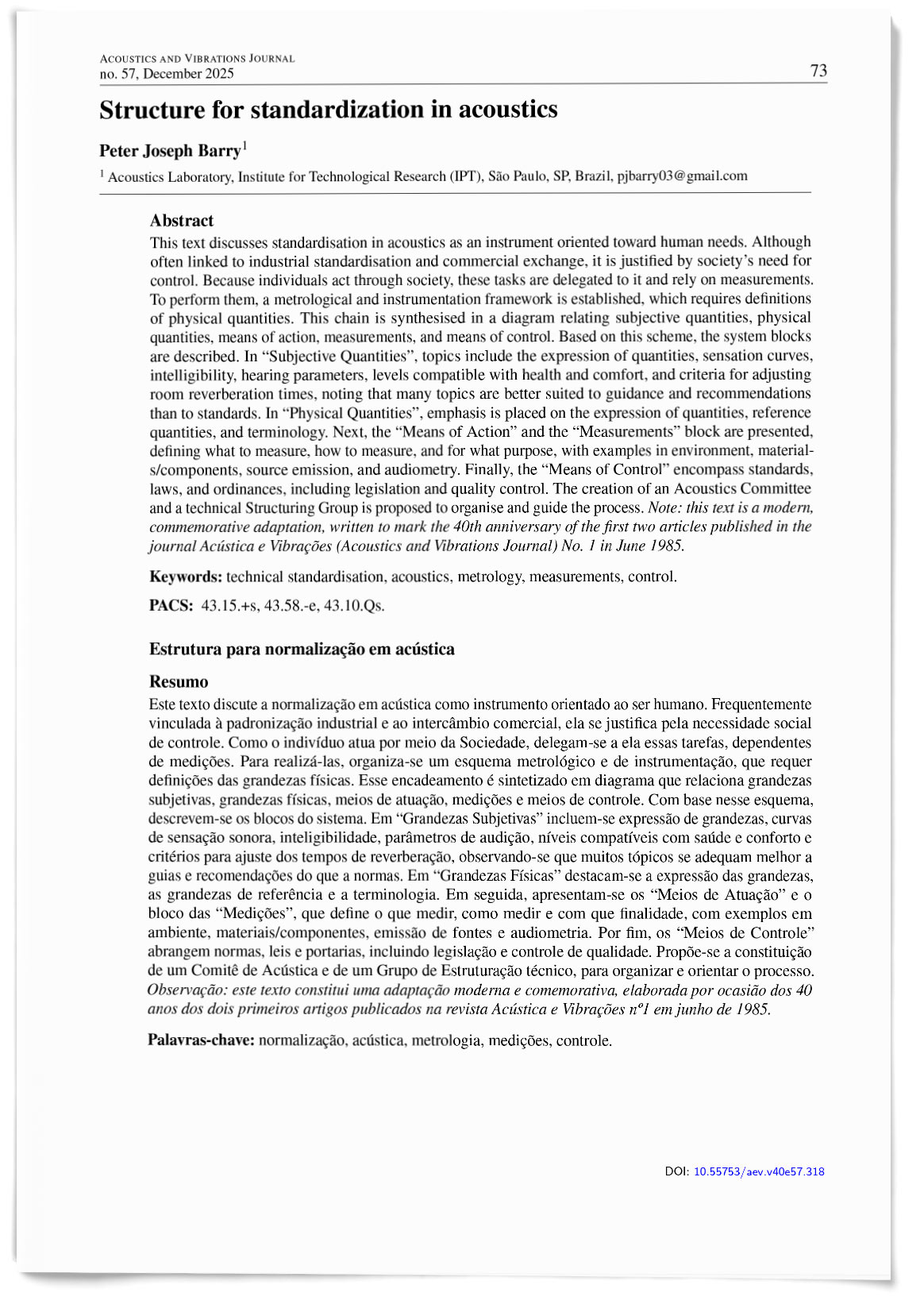
This text discusses standardisation in acoustics as an instrument oriented toward human needs. Although often linked to industrial standardisation and commercial exchange, it is justified by society’s need for control. Because individuals act through society, these tasks are delegated to it and rely on measurements. To perform them, a metrological and instrumentation framework is established, which requires definitions of physical quantities. This chain is synthesised in a diagram relating subjective quantities, physical quantities, means of action, measurements, and means of control. Based on this scheme, the system blocks are described. In "Subjective Quantities", topics include the expression of quantities, sensation curves, intelligibility, hearing parameters, levels compatible with health and comfort, and criteria for adjusting room reverberation times, noting that many topics are better suited to guidance and recommendations than to standards. In "Physical Quantities", emphasis is placed on the expression of quantities, reference quantities, and terminology. Next, the "Means of Action" and the "Measurements" block are presented, defining what to measure, how to measure, and for what purpose, with examples in environment, materials/components, source emission, and audiometry. Finally, the "Means of Control" encompass standards, laws, and ordinances, including legislation and quality control. The creation of an Acoustics Committee and a technical Structuring Group is proposed to organise and guide the process.
Note: this text is a modern, commemorative adaptation, written to mark the 40th anniversary of the first two articles published in the journal "Acústica e Vibrações" (Acoustics and Vibrations Journal) No. 1 in June 1985.
Tradução
Referências
Downloads
Publicado
Como Citar
Edição
Seção
Licença
Copyright (c) 2025 Acústica e Vibrações

Este trabalho está licenciado sob uma licença Creative Commons Attribution-NonCommercial-ShareAlike 4.0 International License.