
Editorial — Acoustics & Vibration Journal nº 56
Palavras-chave:
AeV, EditorialResumo
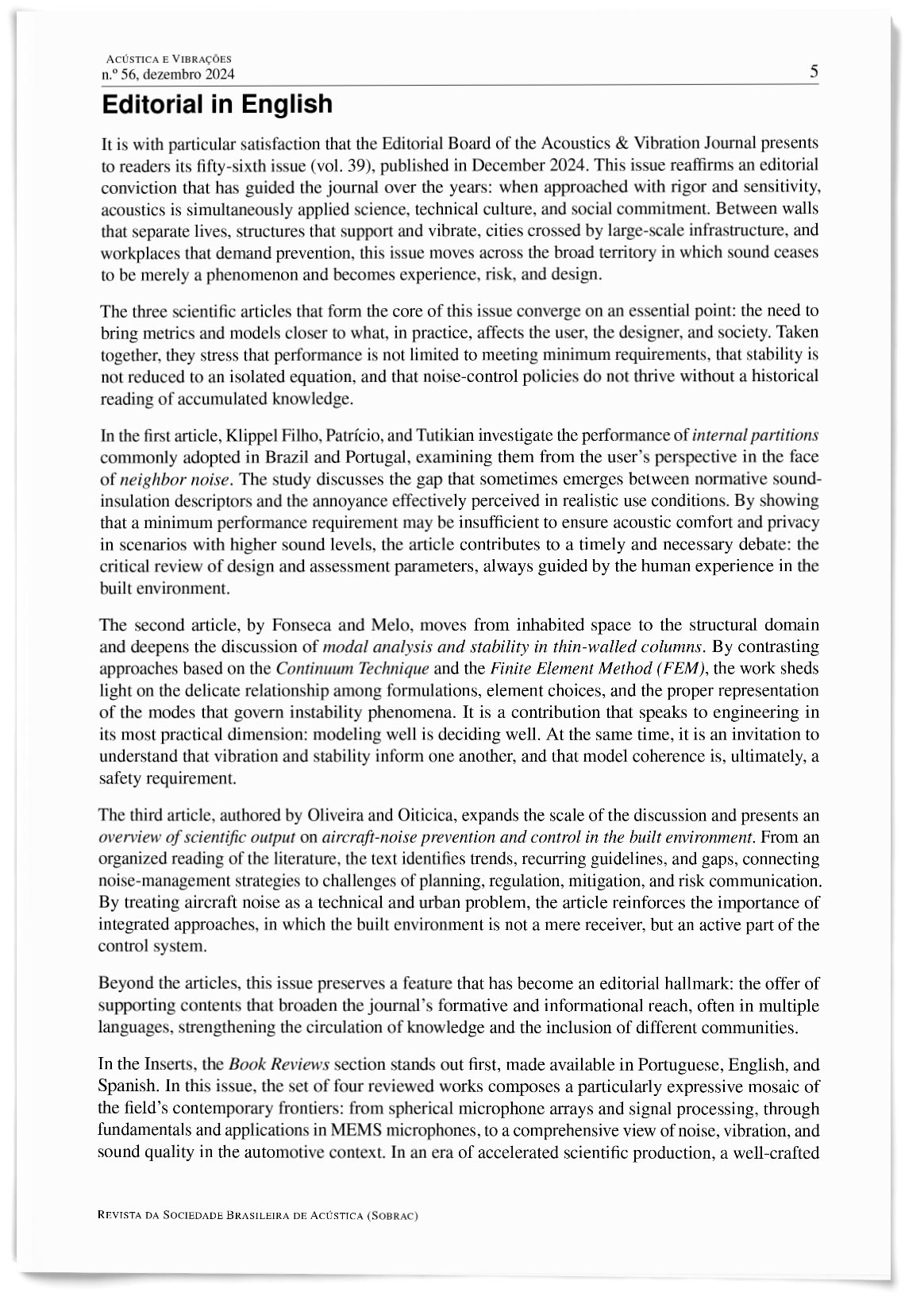
It is with particular satisfaction that the Editorial Board of the Acoustics & Vibration Journal presents to readers its fifty-sixth issue (vol. 39), published in December 2024. This issue reaffirms an editorial conviction that has guided the journal over the years: when approached with rigor and sensitivity, acoustics is simultaneously applied science, technical culture, and social commitment. Between walls that separate lives, structures that support and vibrate, cities crossed by large-scale infrastructure, and workplaces that demand prevention, this issue moves across the broad territory in which sound ceases to be merely a phenomenon and becomes experience, risk, and design.
The three scientific articles that form the core of this issue converge on an essential point: the need to bring metrics and models closer to what, in practice, affects the user, the designer, and society. Taken together, they stress that performance is not limited to meeting minimum requirements, that stability is not reduced to an isolated equation, and that noise-control policies do not thrive without a historical reading of accumulated knowledge.
In the first article, Klippel Filho, Patrício, and Tutikian investigate the performance of internal partitions commonly adopted in Brazil and Portugal, examining them from the user’s perspective in the face of neighbor noise. The study discusses the gap that sometimes emerges between normative sound- insulation descriptors and the annoyance effectively perceived in realistic use conditions. By showing that a minimum performance requirement may be insufficient to ensure acoustic comfort and privacy in scenarios with higher sound levels, the article contributes to a timely and necessary debate: the critical review of design and assessment parameters, always guided by the human experience in the built environment.
The second article, by Fonseca and Melo, moves from inhabited space to the structural domain and deepens the discussion of modal analysis and stability in thin-walled columns. By contrasting approaches based on the Continuum Technique and the Finite Element Method (FEM), the work sheds light on the delicate relationship among formulations, element choices, and the proper representation of the modes that govern instability phenomena. It is a contribution that speaks to engineering in its most practical dimension: modeling well is deciding well. At the same time, it is an invitation to understand that vibration and stability inform one another, and that model coherence is, ultimately, a safety requirement.
The third article, authored by Oliveira and Oiticica, expands the scale of the discussion and presents an overview of scientific output on aircraft-noise prevention and control in the built environment. From an organized reading of the literature, the text identifies trends, recurring guidelines, and gaps, connecting noise-management strategies to challenges of planning, regulation, mitigation, and risk communication. By treating aircraft noise as a technical and urban problem, the article reinforces the importance of integrated approaches, in which the built environment is not a mere receiver, but an active part of the control system.
Beyond the articles, this issue preserves a feature that has become an editorial hallmark: the offer of supporting contents that broaden the journal’s formative and informational reach, often in multiple languages, strengthening the circulation of knowledge and the inclusion of different communities.
In the Inserts, the Book Reviews section stands out first, made available in Portuguese, English, and Spanish. In this issue, the set of four reviewed works composes a particularly expressive mosaic of the field’s contemporary frontiers: from spherical microphone arrays and signal processing, through fundamentals and applications in MEMS microphones, to a comprehensive view of noise, vibration, and sound quality in the automotive context. In an era of accelerated scientific production, a well-crafted review serves a noble role: to guide, to contextualize, and to open doors to deeper reading.
Also among the inserts, the journal publishes the official material of the International Noise Awareness Day (INAD Brazil 2024), likewise in multilingual versions. With a focus on noise at work and the axis of prevention, the insert brings together acoustic engineering, occupational health, and education, proposing guidelines and encouraging sustained actions throughout the year. By welcoming this content, the journal reaffirms that communicating science is part of addressing the problem: noise is pervasive, cumulative, and often normalized; for that very reason, it must be placed at the center of public debate with technical accuracy and accessible language.
In the News & Reviews section, the issue brings together two complementary contributions. The first presents the HBK 2255 with Building Acoustics Partner, in Portuguese, English, and Spanish versions, describing an instrumental solution geared to building-acoustics measurements, with emphasis on workflow, integration among devices, and reporting and documentation conveniences. In a field where data reliability depends as much on method as on execution in the field, discussing tools and workflow is, in itself, a way to raise measurement standards.
The second contribution features the III Conrado Silva Student Acoustics Competition (CACS), documenting an emblematic moment of training and renewal. By publicizing and valuing student initiatives, the journal makes visible what sustains the field’s future: a community in which learning, presenting, debating, and receiving critical feedback are part of the culture. It is also an indirect tribute to Conrado Silva’s legacy, whose influence remains alive in technical curiosity and in the seriousness with which new generations take on real problems.
Finally, the Calls section broadens the horizon of the issue by offering a direct service to the community: an organized list of 90 acoustics events in Brazil and around the world (2024–2029), in Portuguese and English, supporting academic and professional planning. In addition, it extends invitations to key meetings on the calendar: Inter-Noise 2025, to be held in São Paulo (SP), and the XVIII ENCAC and XIV ELACAC 2025, in São Carlos (SP), also with material in Spanish, reinforcing the Latin American dimension of technical dialog. In addition, the journal invites new members to join Sobrac, reminding us that the vitality of a scientific society is measured not only by its proceedings, but by its capacity to bring together people, projects, education, research, and institutional action.
Across these pages, the Acoustics & Vibration Journal reaffirms its commitment to the qualified dissemination of knowledge in acoustics, vibrations, and related areas, preserving the rigor of the editorial process and its openness to formative, technical, and community-oriented contents. We thank the authors for their trust, the reviewers for their careful and generous work, and everyone involved in the issue for making possible yet another number that simultaneously informs, inspires, and invites reflection.
May this issue be read as one reads a good design: with attention to detail, awareness of context, and respect for the end user.
Enjoy your reading!
Sincerely,
Editors A&V n° 56, December 2024.
Tradução
Downloads
Publicado
Como Citar
Edição
Seção
Licença
Copyright (c) 2024 Acústica e Vibrações

Este trabalho está licenciado sob uma licença Creative Commons Attribution-NonCommercial-ShareAlike 4.0 International License.