
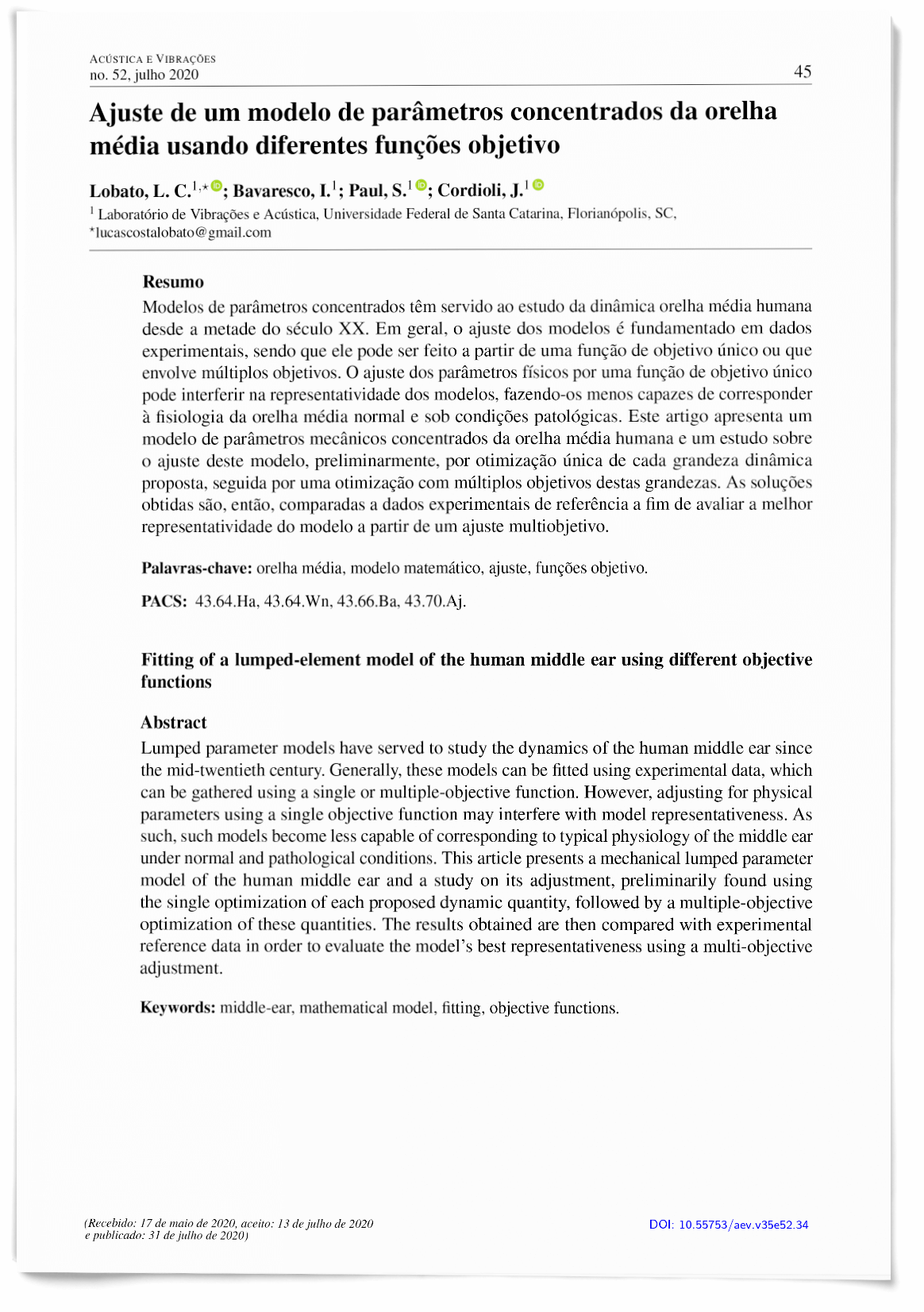
Ajuste de um modelo de parâmetros concentrados da orelha média usando diferentes funções objetivo
DOI:
https://doi.org/10.55753/aev.v35e52.34Palavras-chave:
orelha média, modelo matemático, ajuste, funções objetivoResumo
Modelos de parâmetros concentrados têm servido ao estudo da dinâmica orelha média humana desde a metade do século XX. Em geral, o ajuste dos modelos é fundamentado em dados experimentais, sendo que ele pode ser feito a partir de uma função de objetivo único ou que envolve múltiplos objetivos. O ajuste dos parâmetros físicos por uma função de objetivo único pode interferir na representatividade dos modelos, fazendo-os menos capazes de corresponder à fisiologia da orelha média normal e sob condições patológicas. Este artigo apresenta um modelo de parâmetros mecânicos concentrados da orelha média humana e um estudo sobre o ajuste deste modelo, preliminarmente, por otimização única de cada grandeza dinâmica proposta, seguida por uma otimização com múltiplos objetivos destas grandezas. As soluções obtidas são, então, comparadas a dados experimentais de referência a fim de avaliar a melhor representatividade do modelo a partir de um ajuste multiobjetivo.
Referências
MOORE, B.C.J. An Introduction to the Psychology of Hearing. Emerald, 2012. ISBN 9781780520384. Disponível em: https://books.google.com.br/books?id=LM9U8e28pLMC.
IHRLE, Sebastian; EIBER, Albrecht; EBERHARD, Peter. Modeling of the incudomalleolar joint within a biomechanical model of the human ear. Multibody System Dynamics, v. 39, n. 4, p. 291–310, Apr 2017. ISSN 1573-272X. Disponível em: https://doi.org/10.1007/s11044-016-9550-7.
GREEF, Daniel De; BUYTAERT, Jan AN; AERTS, Johan RM; HOOREBEKE, Luc Van; DIERICK, Manuel; DIRCKX, Joris. Details of human middle ear morphology based on micro-ct imaging of phosphotungstic acid stained samples. JOURNAL OF MORPHOLOGY, v. 276, n. 9, p. 1025–1046, 2015. ISSN 0362-2525. Disponível em: http://dx.doi.org/10.1002/jmor.20392.
GOTTLIEB, Peter K.; VAISBUCH, Yona; PURIA, Sunil. Human ossicular-joint flexibility transforms the peak amplitude and width of impulsive acoustic stimuli. The Journal of the Acoustical Society of America, v. 143, n. 6, p. 3418–3433, 2018. Disponível em: https://doi.org/10.1121/1.5039845.
WILLCOX, Thomas O.; ARTZ, Gregory J. Chapter 26 - auditory system disorders. In: SCHAPIRA, Anthony H.V.; BYRNE, Edward; DIMAURO, Salvatore; FRACKOWIAK, Richard S.J.; JOHNSON, Richard T.; MIZUNO, Yoshikuni; SAMUELS, Martin A.; SILBERSTEIN, Stephen D.; WSZOLEK, Zbigniew K. (Ed.). Neurology and Clinical Neuroscience. Philadelphia: Mosby, 2007. p. 329 – 335. ISBN 978-0-323-03354-1. Disponível em: http://www.sciencedirect.com/science/article/pii/B9780323033541500304.
WHO. World Health Organization: Global Costs of Unaddressed Hearing Loss and Cost-effectiveness of Interventions. World Health Organization, 2017. ISBN 9789241512046. Disponível em: https://books.google.com.br/books?id=6LOaswEACAAJ.
PAOLIS, Annalisa De; BIKSON, Marom; NELSON, Jeremy T.; RU, J. Alexander de; PACKER, Mark; CARDOSO, Luis. Analytical and numerical modeling of the hearing system: Advances towards the assessment of hearing damage. Hearing Research, v. 349, p. 111 – 128, 2017. ISSN 0378-5955. Noise in the Military. Disponível em: http://www.sciencedirect.com/science/article/pii/S0378595516302787.
ONCHI, Yutaka. A study of the mechanism of the middle ear. The Journal of the Acoustical Society of America, v. 21, n. 4, p. 404–410, 1949. Disponível em: https://doi.org/10.1121/1.1906527.
MøLLER, Aage R. Network model of the middle ear. The Journal of the Acoustical Society of America, v. 33, n. 2, p. 168–176, 1961. Disponível em: https://doi.org/10.1121/1.1908610.
ZWISLOCKI, J. Analysis of the middle-ear function. part i: Input impedance. The Journal of the Acoustical Society of America, v. 34, n. 9B, p. 1514–1523, 1962. Disponível em: https://doi.org/10.1121/1.1918382.
FENG, B.; GAN, R. Z. Lumped parametric model of the human ear for sound transmission. Biomechan Model Mechanobiol, n. 3, p. 33–47, 2004.
GARLAND, Philip. A lumped parameter mechanical model of tensor tympani muscle contraction of the middle ear. Proceedings of Meetings on Acoustics, v. 11, n. 1, p. 050001, 2010. Disponível em: https://asa.scitation.org/doi/abs/10.1121/1.3592354.
RUSINEK, Rafal. Sound transmission in the first nonlinear model of middle ear with an active implant. Mathematical Problems in Engineering, 2020. Disponível em: https://doi.org/10.1155/2020/4580467.
VOSS, Susan E.; ROSOWSKI, John J.; MERCHANT, Saumil N.; PEAKE, William T. Middle-ear function with tympanic-membrane perforations. II. A simple model. The Journal of the Acoustical Society of America, v. 110, n. 3, p. 1445–1452, 2001. Disponível em: https://doi.org/10.1121/1.1394196.
O’CONNOR, Kevin N.; PURIA, Sunil. Middle-ear circuit model parameters based on a population of human ears. The Journal of the Acoustical Society of America, v. 123, n. 1, p. 197–211, 2008. Disponível em: https://doi.org/10.1121/1.2817358.
VOSS, Susan E.; MERCHANT, Gabrielle R.; HORTON, Nicholas J. Effects of middle-ear disorders on power reflectance measured in cadaveric ear canals. Ear and Hearing, v. 33, n. 2, p. 195–208, 2012. Disponível em: https://journals.lww.com/ear-hearing/Abstract/2012/03000/Effects_of_Middle_Ear_Disorders_on_Power.5.aspx.
XUE, Lin; LIU, Houguang; WANG, Wenbo; YANG, Jianhua; ZHAO, Yu; HUANG, Xinsheng. The role of third windows on human sound transmission of forward and reverse stimulations: A lumped-parameter approach. The Journal of the Acoustical Society of America, v. 147, n. 3, p. 1478–1490, 2020. Disponível em: https://doi.org/10.1121/10.0000846.
VOSS, Susan E.; ROSOWSKI, John J.; MERCHANT, Saumil N.; PEAKE, William T. Acoustic responses of the human middle ear. Hearing Research, v. 150, n. 1, p. 43 – 69, 2000. ISSN 0378-5955. Disponível em: http://www.sciencedirect.com/science/article/pii/S0378595500001775.
ROSOWSKI, John J.; NAKAJIMA, Hideko H.; HAMADE, Mohamad A.; MAHFOUD, Lorice; MERCHANT, Gabrielle R.; HALPIN, Christopher F.; MERCHANT, Saumil N. Ear-canal reflectance, umbo velocity, and tympanometry in normal-hearing adults. Ear and Hearing, v. 33, n. 1, p. 19–34, 2010. Disponível em: https://journals.lww.com/ear-hearing/fulltext/2012/01000/Ear_Canal_Reflectance,_Umbo_Velocity,_and.3.aspx.
NAKAJIMA, Hideko Heidi; ROSOWSKI, John J.; SHAHNAZ, Navid; VOSS, Susan E. Assessment of ear disorders using power reflectance. Ear and hearing, v. 34, n. 1, p. 48–53, 2013.
MERCHANT, Gabrielle R.; MERCHANT, Saumil N.; ROSOWSKI, John J.; NAKAJIMA, Hideko Heidi. Controlled exploration of the effects of conductive hearing loss on wideband acoustic immittance in human cadaveric preparations. Hearing Research, v. 341, p. 19 – 30, 2016. ISSN 0378-5955. Disponível em: http://www.sciencedirect.com/science/article/pii/S0378595516300259.
LOBATO, Lucas; PAUL, Stephan; CORDIOLI, Julio. Statistical analysis of the mechanical and dynamical behavior of the human middle ear from literature data review. Submetido para publicação, 2020.
LOBATO, Lucas; CORDIOLI, Julio A.; PAUL, Stephan. Lumped parameter model and Monte Carlo Simulation to study middle ear uncertainties. In: 23RD INTERNATIONAL CONGRESS ON ACOUSTICS. Deutsche Gesellschaft für Akustik, 2019. Disponível em: https://publications.rwth-aachen.de/record/770195.
VOLANDRI, G.; PUCCIO, F. Di; FORTE, P.; CARMIGNANI, C. Biomechanics of the tympanic membrane. Journal of Biomechanics, v. 44, n. 7, p. 1219 – 1236, 2011. ISSN 0021-9290. Disponível em: http://www.sciencedirect.com/science/article/pii/S0021929011000224.
CHENG, Tao; DAI, Chenkai; GAN, Rong Z. Viscoelastic properties of human tympanic membrane. Annals of Biomedical Engineering, v. 35, n. 2, p. 305–314, Feb 2007. Disponível em: https://doi.org/10.1007/s10439-006-9227-0.
KARMODY, C. S.; NORTHROP, C. C.; LEVINE, S. R. The incudostapedial articulation: new concepts. Otol. Neurotol, n. 30, p. 900–997, 2009. Disponível em: https://journals.lww.com/otology-neurotology/Abstract/2009/10000/The_Incudostapedial_Articulation__New_Concepts.22.aspx.
IHRLE, S.; GERIG, R.; DOBREV, I.; RööSLI, C.; SIM, J.H.; HUBER, A.M.; EIBER, A. Biomechanics of the incudo-malleolar-joint – experimental investigations for quasi-static loads. Hearing Research, v. 340, p. 69 – 78, 2016. ISSN 0378-5955. MEMRO 2015 – Basic Science meets Clinical Otology. Disponível em: http://www.sciencedirect.com/science/article/pii/S0378595515300861.
ZHANG, Xiangming; GAN, Rong Z. Experimental measurement and modeling analysis on mechanical properties of incudostapedial joint. Biomechanics and Modeling in Mechanobiology, v. 10, n. 5, p. 713–726, Oct 2011. ISSN 1617-7940. Disponível em: https://doi.org/10.1007/s10237-010-0268-9.
SIM, Jae Hoon; CHATZIMICHALIS, Michail; LAUXMANN, Michael; RÖÖSLI, Christof; EIBER, Albrecht; HUBER, Alexander M. Complex stapes motions in human ears. Journal of the Association for Research in Otolaryngology, v. 11, n. 3, p. 329–341, Sep 2010. ISSN 1438-7573. Disponível em: https://doi.org/10.1007/s10162-010-0207-6.
CALERO, Diego; LOBATO, Lucas; PAUL, Stephan; CORDIOLI, Júlio A. Analysis of the Human Middle Ear Dynamics Through Multibody Modeling. Journal of Biomechanical Engineering, v. 142, n. 7, 05 2020. ISSN 0148-0731. 071012. Disponível em: https://doi.org/10.1115/1.4046689.
VOSS SUSAN E. HORTON, Nicholas; WOODBURY, Rebecca R.; SHEFFIELD, Kathryn N. Sources of variability in reflectance measurements on normal cadaver ears. Ear and Hearing, v. 29, n. 4, p. 651–665, 2008. Disponível em: https://doi.org/10.1097/AUD.0b013e318174f07c.
CHEN, Huayue; OKUMURA, Toshihiko; EMURA, Shoichi; SHOUMURA, Shizuko. Scanning electron microscopic study of the human auditory ossicles. Annals of Anatomy - Anatomischer Anzeiger, v. 190, n. 1, p. 53 – 58, 2008. ISSN 0940-9602. Disponível em: http://www.sciencedirect.com/science/article/pii/S0940960207000866.
LEMMERLING, M M; STAMBUK, H E; MANCUSO, A A; ANTONELLI, P J; KUBILIS, P S. Ct of the normal suspensory ligaments of the ossicles in the middle ear. American Journal of Neuroradiology, American Journal of Neuroradiology, v. 18, n. 3, p. 471–477, 1997. ISSN 0195-6108. Disponível em: http://www.ajnr.org/content/18/3/471.
Downloads
Publicado
Como Citar
Edição
Seção
Licença
Copyright (c) 2020 Acústica e Vibrações

Este trabalho está licenciado sob uma licença Creative Commons Attribution-NonCommercial-ShareAlike 4.0 International License.